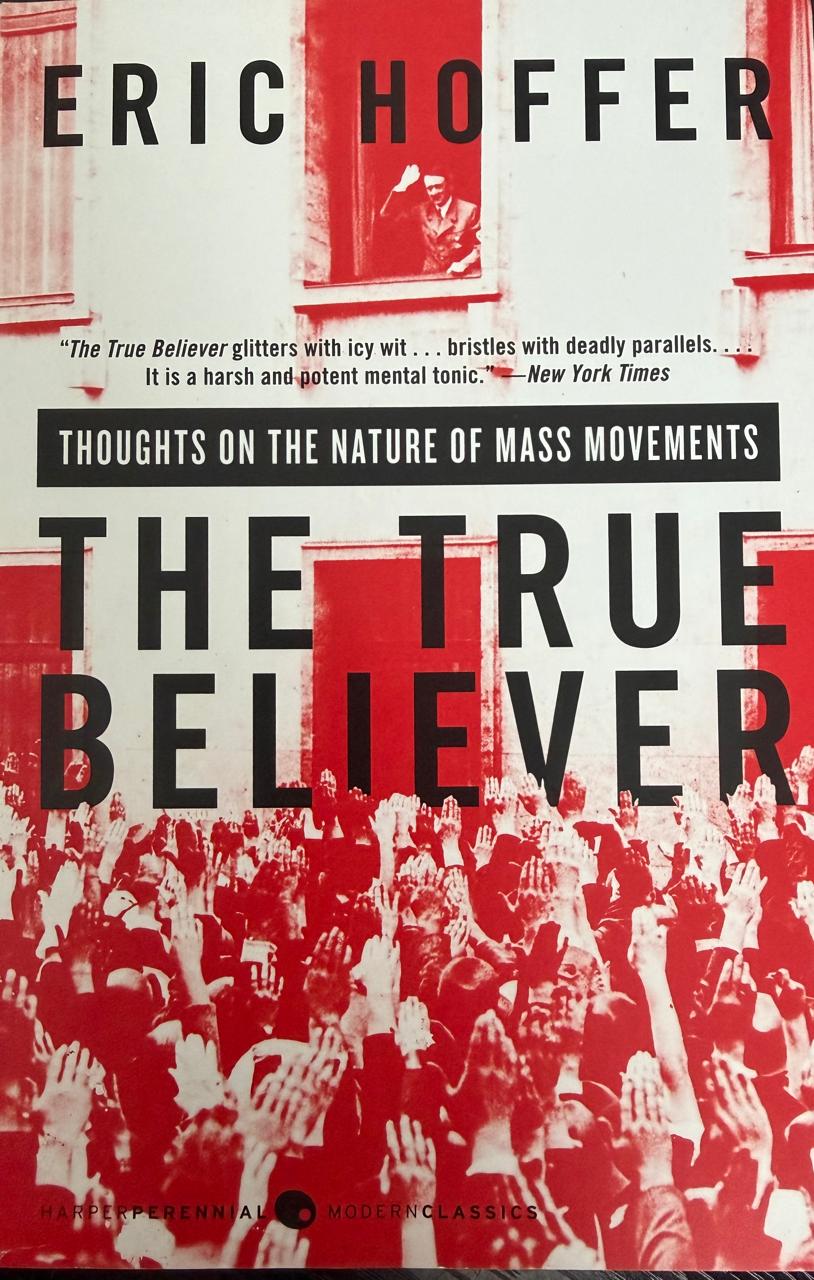
The True Believer (by Eric Hoffer)

Publisher: Harper & Row Publishers, Harperperennial.
Published at: Harper & Row Publishers, Inc. 1951, Perennial Library Edition 1966 (Reset 1989)
Goodreads: https://www.goodreads.com/book/show/158981399-the-true-beliver
Wiki: https://en.wikipedia.org/wiki/The_True_Believer
… but I am not a believer!
This book landed on my radar the way most things do now: a YouTube doom-scroll session, where an algorithm decided I needed to know about Eric Hoffer. And honestly, it was right! Watching at least five mass movements from a distance (or from-not-so-far-away), I always sensed there was some sort of science to it - some psychology, some philosophy that explains why every protest doesn’t just fizzle out, and why some actually tip into civil coup d'état. To be very honest, that idea always scared me. Because if there’s a formula, there’s a way to misuse it - a manual for manipulation.
So when I heard about The True Believer, I readily collected it. But then it sat on my shelf. It took my own home country going through real political turmoil (dividing people into mostly two fierce sides: for and against and also unified them all as victims) - for the book to feel urgent.
Suddenly, reading it wasn’t abstract anymore; it was like reading a field manual for the chaos playing out around me.
Eric Hoffer (1902 - 1983) was a self-taught longshoreman-turned-philosopher whose dockside reflections gave us The True Believer, a quirky, quotable, full of sharp one-liner, anatomy of why people swap their own messy life for the tidy certainties of mobs and movements.
His work still matters because in an era of tribal politics and online firehose of outrage, Hoffer’s punchy insight that the frustrated often seek refuge in causes bigger than themselves - helps explain everything from political cults to the psychology behind today’s mass movements.
… that’s how it’s done!
In The True Believer, Eric Hoffer sets out to examine not what people believe, but why they are so ready to believe at all.
The book opens with “The Desire for Change,” where he argues that mass movements are born less from misery than from frustration - from those who feel their lives are spoiled, stalled, or insignificant. From there, in “The Desire for Substitutes,” he makes his sharp claim: when the individual self feels inadequate, people look to lose it in something vast - nation, religion, revolution - in collectives. “Faith in a holy cause,” he writes, “is to a considerable extent a substitute for the lost faith in ourselves.”
Hoffer then sketches the roles of different types of participants - the frustrated, the intellectuals (“men of words”), the activists (“men of action”) - each playing their part in fermenting unrest, brewing movements. In “The Ambitious Facing Unlimited Opportunity,” he provocatively suggests that even those with open horizons may crave discipline and collective purpose. Finally, through “Unifying Agents” and “The Fanatics,” he shows how hatred, slogans, and absolute certainty weld strangers into a single will - proving his central thesis: movements differ in costume, but their inherent psychological / philosophical machinery is strikingly the same.
My takeaways
I have a few takeaways to be honest. Some of them opened a new window or two, some of them are verifying my gut and some of them are kind of awe - that this idea can be expressed in such easy manner. Key points I would like to mention are:
1. Frustration is rocket fuel.
Movements don’t begin with the most oppressed, but with the most dislocated - those who feel their lives lack dignity or direction. So the most severe victims are not really the first-mover in a movement. In today’s world of digital comparison and economic anxiety, that pool is … not small.
2. The self is heavy; causes are light.
Hoffer suggests people escape the burden of individuality by dissolving into collective identity. Individuality becomes a responsibility to maintain which requires more and deeper work. Whereas collective identity is more powerful. Social media tribes and algorithmic echo chambers make that trade even easier now.
3. Hatred unites faster than hope.
A shared enemy binds strangers quickly. That was always have been my guess that people gets bonded more easily not by shared virtue or shared cause - but by shared hate towards something or somebody. Hoffer’s darker observations about scapegoating feel uncomfortably current in polarized politics.
4. Leaders matter less than mood.
Charisma helps, but the emotional climate matters more. When the air is thick with grievance, any spark can look like destiny. And that is one point which is used to manipulate people/mass into doing things that would have been impossible for them to even think about otherwise. So a good (in all sense) leader plays an enormous role to guide the fleet into right direction.
5. Fanatics aren’t deep thinkers.
They are certain! No matter the issues are right or wrong - fanatics are always certain! Hoffer is blunt, sometimes unfairly so, about believers’ intellectual rigidity. Today’s absolutist and wokeism discourse shows his warning still lands.
Other relevant stuffs
-
Other notable works by Eric Hoffer include
The Ordeal of Change,The Passionate State of Mind, andWorking and Thinking on the Waterfront- all circling themes of change, belief, and human restlessness. -
His life and thought were featured in the documentary The Crowded Life, which leans into the romance of the self-taught thinker. His biography Eric Hoffer: The Longshoreman Philosopher paints a good picture of him as a person and his thought process when he produced his best works.
-
Critics argue he overgeneralizes and flattens historical complexity. Admirers counter that his psychological lens, not historical detail, is the point — and that his aphoristic clarity is precisely why the book endures.
should you or shouldn’t
Yes: if you want a compact, unsettling mirror on why crowds thrill us and why certainty seduces. It’s especially worth reading in politically heated times, when slogans feel louder than rock music.
Maybe not: if you’re looking for data-heavy scholarship or a neutral tone while dissecting through human psychology in a light tone. Hoffer writes in bold strokes, not footnotes - in an Epigram-laden style.
Verdict: read it when the world feels a bit too certain of itself. That’s when Hoffer is most useful.