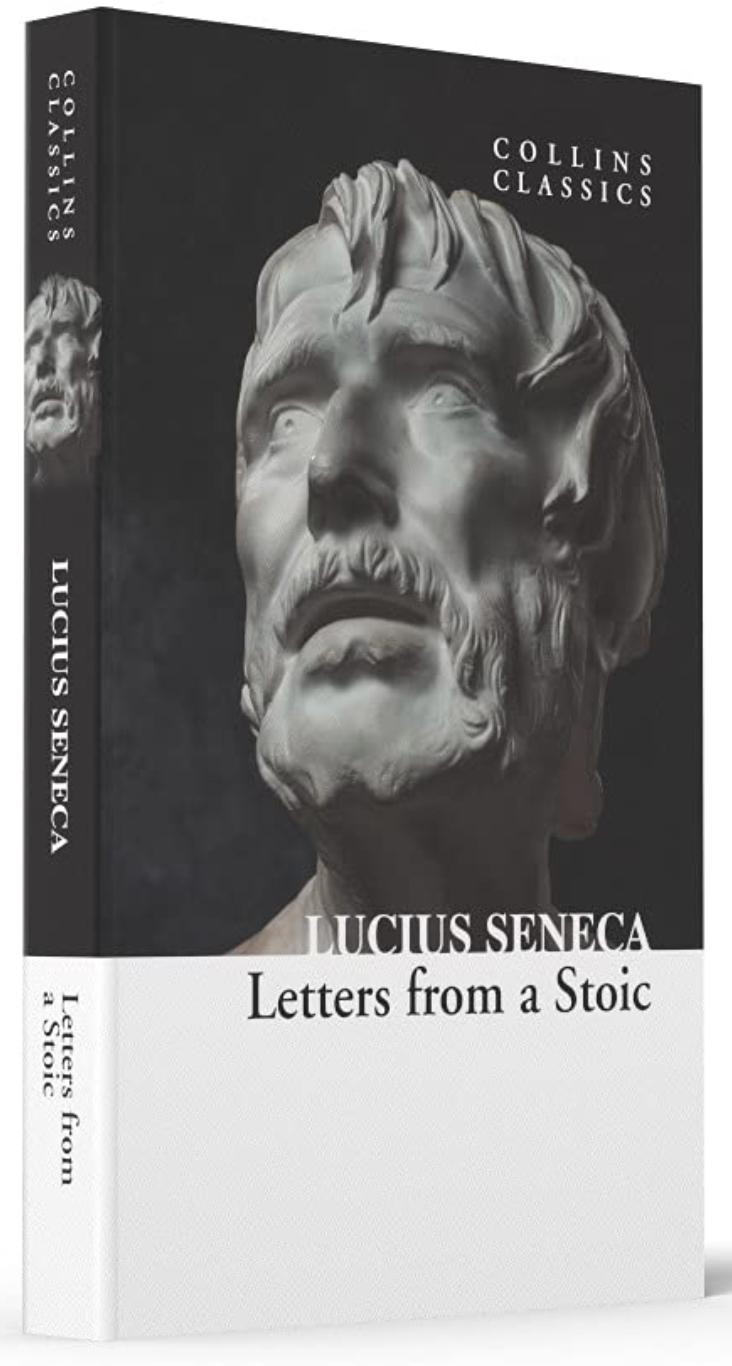
Letters from a Stoic (by Lucius Seneca)

Publisher: HarperCollins Publisher, UK
Published at: January 01, 1964
Goodreads: https://www.goodreads.com/book/show/189585102-letters-from-a-stoic-collins-classics-paperback-17-september-2020
Wiki: https://en.wikipedia.org/wiki/Epistulae_Morales_ad_Lucilium
Stoic!!!
“No man can live a happy life, or even a supportable life, without the study of wisdom”
When I first saw the Marcus Aurelius’ book "Meditation" during my early 20s, I took it as the cover says, a book for Meditation. Needless to say how wrong was I! Similar thing happened couple years later when I heard about the name "Seneca", I took him as an ancient politician who may be has written some book related to political science.
I was all during my undergrad days and I haven’t touched any of the books, for no particular reasons, other than reluctance to bite on something hard.
Then on a re-re-watch of the movie Gladiator, I discovered that Marcus Aurelius was a character in there (although historically inaccurate). It all clicked and I went on to collect the book Mediation, only to take dust for few more years. On some random day filled with boredom and despair, I took the book at last and obviously was fascinated by it.
But that’s a different write up may be. That experience led me to collect this book "Letters from a Stoic".
Stoicism has been a growing trend on social media for various reasons and goals, with a significant spike in popularity appearing around the year 2020. We can speculate that it’s more likely another effect of the COVID-19 era bringing on tests upon uncertainty, hopelessness, perseverance, etc. Silently and rapidly, it went "viral" on Instagram, TikTok - flying on the short from of digital content, and not-so-surprisingly dominantly among "tech-bro" audiences. Sales for Marcus Aurelius’ "Meditations" got a huge raise.
But as we know social media contents is all about grabbing the 8 second attention span of the viewers to gain “engagement”, “monetization” - little harder topics like Stoicism are often gets dumbed down - even it has serious mental health benefits. Also it is "trendy" to do something apparently “serious” in comparison to do stupid dancing.
But Stoicism is not only a philosophy to me - it’s also a way of thinking, reflecting and responding to situation - while actively not thinking about this.
It’s more like absorbing the gist out of it.
This book, a collection of 124 letters, was originally titled "Ad Lucilium Epistulae Morales" or Moral letters to Lucilius. They are not just letter to the Roman Lawyer/Pleader/Procurator Lucilius, they are in fact essays. Discussing everyday events and terms in light of Stoic philosophy. Life, politics, death everything is included in this.
Having talked about death, he himself unfortunately had to embrace death by suicide by order of emperor Nero. He was probably not at all afraid of this - as he said himself: "Life, if courage to die be lacking, is slavery!"
Hence I thought to put my learnings from this book in written form - “before i forget”!
What’s in there …
Letters from a Stoic is not a book to be “read” in the traditional sense. Rather it is one that needs to be dipped into, return to, and occasionally argue.
Across its letters, Seneca writes with a mix of intimacy and authority, offering reflections that feel as personal as they are philosophical.
It’s a collection of viewpoints, discourses, parables, and advice, stitched together by a persistent concern: “how to live well”.
The opening letter, “On discursiveness in reading”, immediately sets the tone. Seneca argues that hopping from book to book scatters the mind. Instead, he says, linger with one great thinker. It is a fitting start, reminding us this collection demands the same patience.
From there, the topics unfold like a quiet conversation.
"On Philosophy and Friends (Letter 9)”, Seneca wrote that a wise person is emotionally self-sufficient but still seeks friends for the sake of practicing virtue. True friendship is built on sharing a life, not seeking personal gain.
"On the Blush of Modesty (Letter 11)” he suggests that involuntary physical traits, like blushing, are biological and cannot be “cured” by wisdom. Use the internal image of a virtuous guardian to regulate your behavior when nature fails.
He reflected on death in "On Old Age and Death (Letter 26)” as old age is the final testing ground for your principles. Practice “despising death” daily to ensure your philosophy holds firm when the final moment arrives.
"On Style for a Philosopher (Letter 40)” talks about philosophers style. A philosopher’s speech should be calm, clear, and measured. Rapid-fire delivery is for entertainers; a healer of souls speaks with dignity to be truly heard.
"On Being (Letter 58)” - this letter explores the hierarchy of existence and the nature of the universe. It uses abstract metaphysics to remind us that life is fleeting compared to eternal truths.
Seneca gave verdict about drinking (not water I guess) in the letter "On Drunkenness (Letter 83)” as drunkenness is “voluntary insanity” that weakens the mind and exposes hidden vices. A person of character must never surrender their reason to intoxication.
"On Style as a Mirror of Character (Letter 114)” - he reflects on how a person speaks reflects how they live; “speech is the mirror of the mind.” A corrupt, flashy style is a sign of a “flabby” and undisciplined soul.
In "On the True Good and Reason (Letter 124)” we see that Seneca talking about reasoning, happiness, truth, fact. According to him, true happiness is found in the mind, not the senses. While animals seek physical comfort, humans achieve the “True Good” only through the perfection of reason.
Obviously, the above takeaways are not justice to the experience of reading the whole letter.
Am I converted now?
In one line: it’s hard to say.
But mostly no, not fully.
What I find myself doing instead is borrowing the Stoic lens rather than wearing it as a coat. I’m experimenting with its mechanism, the way it reframes discomfort, control, and desire, and placing it in front of my own perspective. Some days, it sharpens things. Other days, it’s not even focusing properly.
So I rotate lenses and filters. Stoicism is one of them—useful, often grounding, but not exclusive. Life, after all, resists single photography style.
That said, I do understand the admiration and hype and hot-arguments in study-circles around Stoicism.
Much of it feels earned. If more people adopted even fragments of this philosophy, the world might not become wiser overnight, obviously.
But it could certainly become more patient, more resilient, and perhaps a little kinder.
… hmm, need to study more …
To really engage with Stoicism, this book alone isn’t enough.
These letters are more compact, finding references, gaps, deeper layers requires further digging.
Exploring other works by Epictetus or Marcus Aurelius, along with modern interpretations, adds texture.
For modern interpretations and explanations How to Think Like a Roman Emperor by Donald Robertson, The Stoicism on Fire by Chris Fisher podcast offers deeper dives, and I find myself watching CosmicSkeptic (Alex O’Connor), unsolicitedadvice YouTube podcasts when I need clarity.
What I found is - Stoicism is not a single read, it is a practice.
And one book alone cannot make a practice.
Would you?
I recommend it.
Don’t swim in the hype, put a gentle step into it lightly.
A small puddle of Stoicism can be surprisingly refreshing.